Motorized vs. Manual Louvered Pergola: Which One Fits Your Yard
The motorized vs. manual louvered pergola decision comes down to how often the louvers will actually get adjusted, because the mechanism that makes motorized systems convenient is also the part that adds cost and long-term maintenance a manual system never carries.
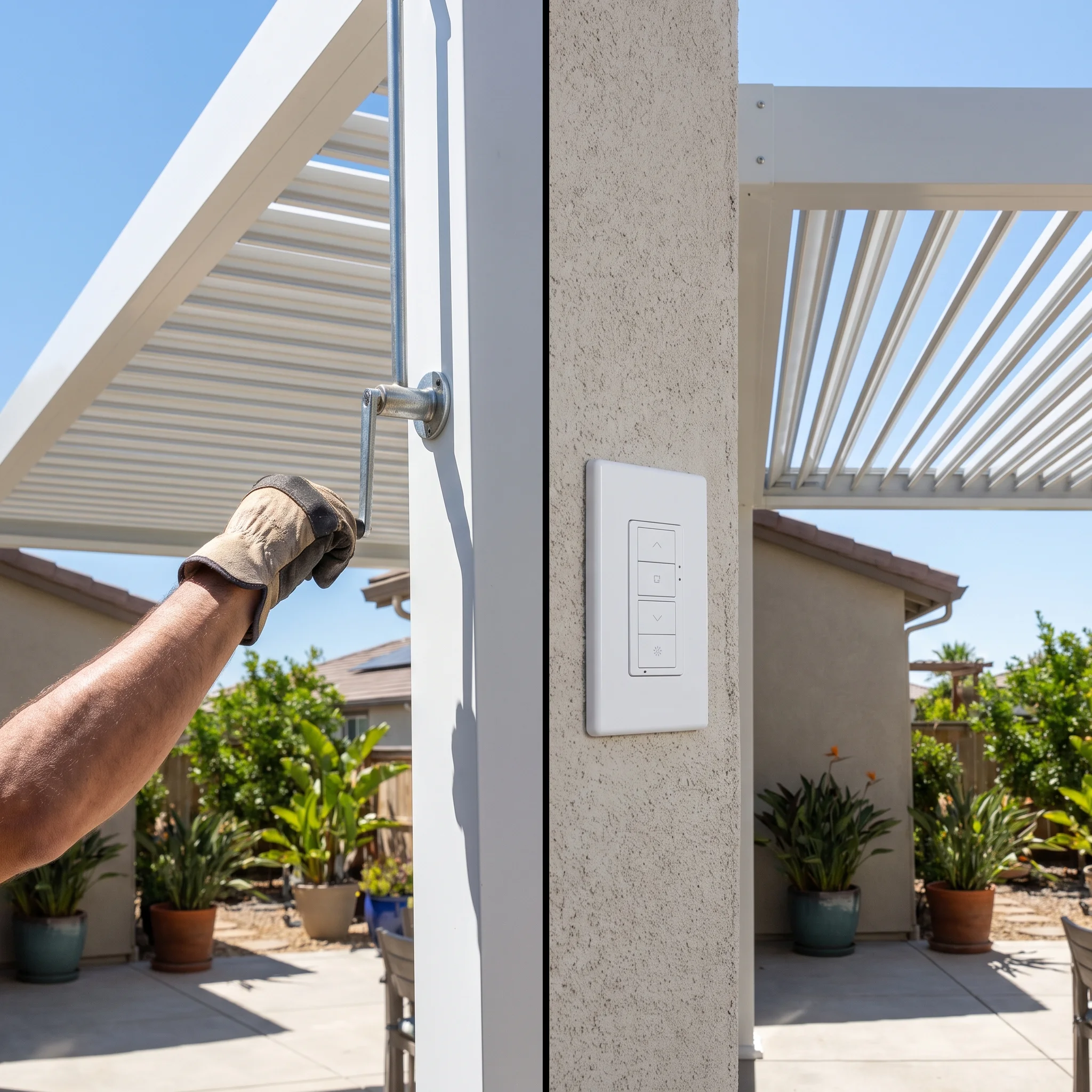
How Each System Actually Operates
A manual louvered pergola uses a hand crank or lever, usually accessible from a fixed point under the structure, to rotate every louver blade in unison between open and closed. A motorized system replaces that mechanical linkage with an electric motor, typically controlled by a wall switch, remote, or smart-home integration, and can often be paired with a rain sensor that closes the louvers automatically if weather moves in while nobody is home to catch it. Both systems achieve the identical physical result — sealed roof for rain, open slats for airflow and light — the difference is entirely in how the adjustment gets triggered.
Where Motorized Pulls Ahead
A motorized louvered pergola earns its added cost on structures where the louvers get adjusted often — multiple times a day as sun angle changes, or a household that wants the rain-sensor auto-close feature so an open pergola does not sit exposed during an unexpected afternoon shower. Integration with smart-home systems and voice control is a real, if secondary, draw for households already invested in that ecosystem, and remote operation matters more on a larger structure where reaching a manual crank point is inconvenient from every seating area.
Where Manual Still Makes Sense
A manual system has no motor, no electronics, and nothing to service beyond the mechanical linkage itself, which is a real long-term maintenance advantage — there is simply less that can fail. For a smaller structure adjusted once or twice a day, or a household that prioritizes minimizing ongoing maintenance and electrical dependency over convenience, manual remains a fully capable choice that costs less to install and less to keep running over the structure's lifetime.
Coastal Considerations That Apply to Both
Salt-air exposure near the coast is a materials question independent of motorized vs. manual — both systems need marine-grade aluminum framing and corrosion-resistant hardware in a coastal zone, and a motorized system additionally needs its motor housing and electrical connections rated for that exposure, which is a spec worth confirming explicitly rather than assuming from a general product listing. Whichever operating system fits the yard, verifying the coastal-rated hardware spec up front is what actually protects the investment over years of exposure.
Related guides
Ready for a written number on your project?